Purpose
This repository presents cleaned and reorganized EE470 coursework as a portfolio project. The projects show how embedded devices can communicate with web services, store data, and support remote control workflows.
A collection of EE470 Internet-of-Things projects combining embedded firmware, web interfaces, sensor data logging, PHP/MySQL backend scripts, and remote device control.
The work demonstrates how embedded devices can send data to web applications, store sensor records in a database, and respond to web-based control commands.
This repository presents cleaned and reorganized EE470 coursework as a portfolio project. The projects show how embedded devices can communicate with web services, store data, and support remote control workflows.
The focus was on connecting firmware, web backends, databases, and dashboards into practical IoT workflows. The work includes sensor logging, registered-node validation, LED/RGB control, dashboard display, and networked communication.
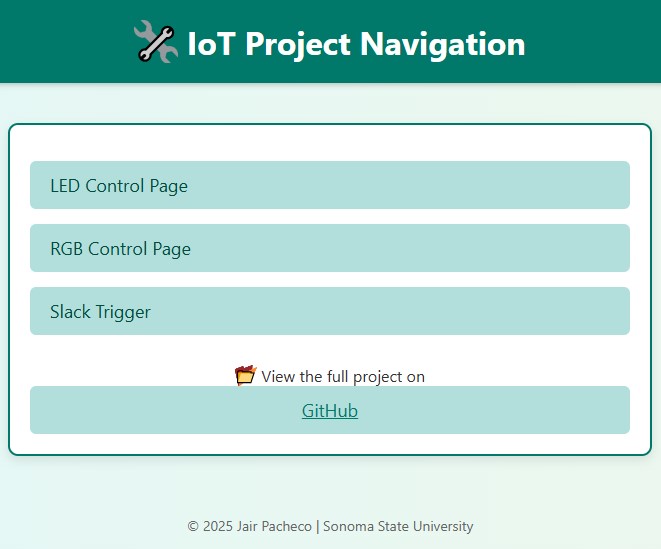
IoT dashboard/control webpage used as part of the EE470 projects. The portfolio version organizes the firmware, web scripts, and database files into separate layers.
Stores registered sensor nodes and temperature/humidity readings in a MySQL database. The dashboard displays sensor records, registered nodes, average readings, and a temperature graph.
Demonstrates web-based control of LED and RGB outputs. Embedded firmware communicates with PHP scripts and text-based state files to retrieve or update output states.
Measures light levels and provides threshold-based feedback using embedded firmware. This project highlights basic sensor input processing and device response logic.
Demonstrates networked communication between embedded firmware and a PHP backend. The project shows how an embedded device can interact with a web-hosted script.
ESP-based firmware collects sensor input, controls outputs, and communicates with web-hosted scripts using network requests.
PHP scripts receive data, validate query parameters, update state files, insert records, and retrieve information from the database.
MySQL tables store registered sensor nodes, sensor readings, and combined views used for dashboard display and analysis.
Web pages display sensor tables, averages, charts, and controls for interacting with IoT devices.
The portfolio version is organized by system layer instead of raw assignment order.
database/
  sensor_database_setup.sql

firmware/
  hqtt/
  lux-monitor/
  rgb-led-control/

web/
  hqtt/
  sensor-dashboard/
rgb-led-control/Before publishing, this repository was reviewed so that WiFi passwords, database credentials, webhook URLs, API keys, and deployment-specific secrets were not exposed.
Sensitive values were replaced with placeholder values such as:
YOUR_WIFI_SSID
YOUR_WIFI_PASSWORD
YOUR_DATABASE_HOST
YOUR_DATABASE_USERNAME
YOUR_DATABASE_PASSWORD
YOUR_DATABASE_NAME
YOUR_IFTTT_WEBHOOK_URLThese EE470 projects demonstrated practical IoT development across firmware, server-side scripting, database storage, and web dashboard visualization. The cleaned portfolio version shows the projects as a connected set of IoT workflows rather than separate assignments.
This work strengthened my experience with embedded network communication, PHP/MySQL data handling, dashboard design, and organizing code into clean public repositories.